Showing posts with label Grand Canyon. Show all posts

Friday, April 19, 2013

Field Course Opportunity: Geology of the Colorado Plateau, June 15-29

(cross-posted from Geotripper, by Garry Hayes)
North Rim of Grand Canyon National Park (yes, Gaelyn, we'll be on the North Rim, hope to see you there!)
There is no place on this planet like the Colorado Plateau. It's hard to find anyplace else on Earth where the crust remained relatively stable for upwards of a billion years, accumulating several miles of horizontal sediments, only to be lifted up rapidly in the last few million. The Colorado River and her tributaries then stripped away much of the sedimentary cover, and cut deep into the underlying metamorphic rocks, which record a violent geologic history of colliding landmasses and mountain-building. The resulting landscape is one of the most beautiful places imaginable.
Angels Landing Trail in Zion National Park, Utah
The plateau country is a training ground for geologists and earth scientists, and has been since the days of John Wesley Powell and Joseph Ives, who were the first to lead research parties into the region (they didn't "discover" the plateau, of course; Native Americans have known the region for thousands of years). If you are curious about learning geology in this incredible region, you might consider joining us as a student (of any age) on our geology field studies course Geology 174, offered under the auspices of Modesto Junior College in Modesto, California.
Goosenecks of the San Juan River, Utah
Our field course will be a grand loop through the plateau country, with investigations of the Mojave National Scenic Preserve, Grand Canyon, Zion, Bryce, Arches, Canyonlands, Capitol Reef, Black Canyon of the Gunnison, Mesa Verde and Great Basin National Parks, as well as many monuments, including Natural Bridges, Navajo, Hovenweap, Colorado, and state parks like Kodachrome Basin, Goblin Valley, and Berlin-Ichthyosaur. It will be an unforgettable two week trip from June 15-29, beginning and ending in Modesto. Information can be found at my school website at  http://hayesg.faculty.mjc.edu/Geology_174_Colorado_Plateau.html.
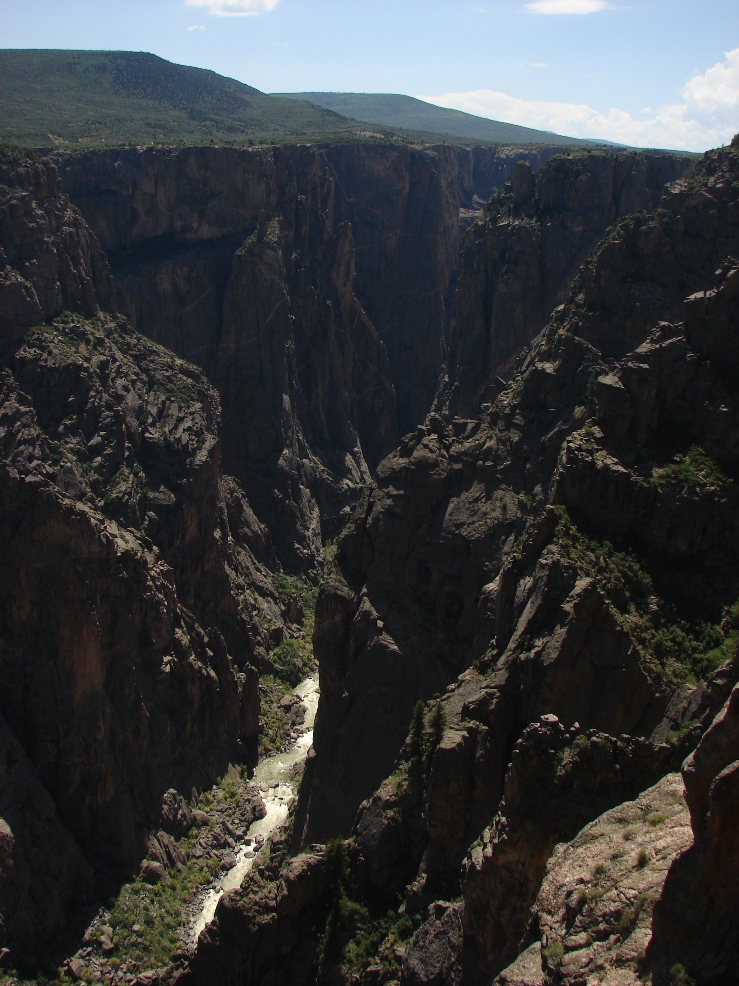
Black Canyon of the Gunnison National Park in Colorado
It's not a comfortable trip...we travel in school vans (which of course are known for their luxuriousness!), we camp every night, and the days can be hot, windy, cold, stormy, and we are out in the middle of anything that happens. But we are staying in beautiful places each night, and there are even showers and laundry available every third day or so! Extensive hiking is not required, but there will be many chances to explore the parks and monuments that we are visiting.
Double Arch in Arches National Park in Utah
Geology 174 is a 3 semester unit course. By end of the course, you will be able to see the landscape the way geologists do: by identifying rocks, minerals and fossils, and interpreting the geological history of an area by working out the sequence of events as exposed in outcrops. If you are a science teacher, you will come home with a collection of photographs that illustrate most of the important principles of geology, and a selection of rocks, minerals and fossils that will make a great classroom teaching tool (legally collected, of course; there are many localities outside of protected parks from which to collect samples).
Canyonlands National Park, Utah
The cost of the trip is $650.00 plus the cost of tuition (Currently $46 per unit for California residents, and $222 per unit for out-of-state residents). The cost includes transportation, food, camp fees, and entrance fees. Participants would want to bring a few dollars along for showers, laundry, and souvenirs.  The food is tasty and plentiful (everyone helps cook and clean!), and the school vans...are vans.

For those of you who live in the Modesto region, we are having an organizational meeting on Monday, April 22 at 7PM in Science 132 of the East Campus at Modesto Junior College. Attendance is not mandatory (and not binding, either), but will be a chance to learn more about the trip and the class. If you can't make it to the meeting, I will send the class materials to you.
Antelope Canyon, Navajo Nation Tribal Park
If you are not in the area, we will be glad to arrange for transportation from nearby airports and train stations (we actually have an Amtrak station in town). Enrollment can be completed online once you are registered with the college (http://www.mjc.edu/index.html). Please contact me through the class website if you have any questions.
Bryce Canyon National Park
Hope to see you out there, back of beyond!

Friday, October 8, 2010

Reflections on an Accretionary Wedge: Why I am a Proud Member of the NAGT


(cross-posted at Geotripper.blogspot.com)

I recently contributed to the latest Accretionary Wedge by talking about my first geology field trip, a 5 day backpack in the depths of the Grand Canyon way back in 1976. Part of the subsequent fallout was the unearthing of pictures of that trip, courtesy of Joy, who was one of my fellow travelers at the time (Facebook has some positive aspects, actually). I am a visually oriented learner, and my memories are most strongly reinforced by photographs, so this was a real pleasure to be able to relive part of my past with these grainy reminders (weren't Kodak Instamatics a wonderful form of photography?). For instance, I don't remember his name, but the bearded gentleman on the left was a very vocal vegetarian, but during the trip he seemed to get hungrier and hungrier, and when we reached the rim at the end of the five days, he looked at the menu in the Grand Canyon Lodge, and ordered a huge steak...

The professor who led that trip into the canyon was my inspiration to become a teacher of geology. That's him in the picture above, explaining to us how the basaltic sills were able to intrude the sediments of the Grand Canyon Supergroup, and how they helped us to place a date on the formation of those sediments. I still remember the shock of realizing that I really could almost literally travel through time by holding and understanding the origin of rocks that were hundreds of millions years old (imagine seeing the imprint of a raindrop that hit the ground 800 million years ago!). Looking at a picture of Marlin at work, I realize that I can trace many of the ideas I use in teaching to the things that he did all those years ago. Innovative ideas in teaching appear all the time, and they can be very effective, but I am reminded that the geological sciences are among the most historical of the academic disciplines as well. I mean this in the sense that there is an academic lineage that gives us a direct link to the founders of the science of geology, and that those brilliant and perceptive minds continue on with a different form of immortality (I wrote about this for a different Accretionary Wedge two years ago). I think what I am really saying is that people often become geologists and teachers not so much because they planned on it the way kids plan on being firefighters or police officers, but because they were inspired to pursue it because of the dedication of their teachers. I know I am over-generalizing about this, but I just don't see someone pursuing an MBA because he or she was inspired by a particularly good economics teacher, though I am willing to listen to counter-arguments! People have many different motivations for choosing their academic goals, after all.

I am thinking about this because I am preparing to drove down to Fresno to attend the fall meeting of the Far Western Section of the National Association of Geoscience Teachers at CSU Fresno (there is still room if you want to drop everything you are doing and drive on into the center of California and see some excellent Sierra Nevada and Coast Range geology- details are here). I joined NAGT nearly fifteen years ago, and have found in my involvement with the organization a sense of history and tradition of excellent teachers, and a myriad of innovative ideas and approaches to the teaching of the geological sciences. It has been a real privilege to work and share ideas with my colleagues from California, Nevada and Hawaii, as well as from all over the country. It's one thing to be inspired to follow an academic discipline because of the work of one or two excellent teachers, and quite another to travel with a large group of talented and innovative teachers who are collectively inspiring hundreds of students. And for that matter, because we encourage students to attend these meetings, it is great to see how they are laying the groundwork for the future of the earth sciences.
1976...that was 34 years ago. Wow. I still have that orange Alpenlite backpack with the innovative wrap-around aluminum frame (I actually worked in their factory for a few months all those years ago). I tried it on the other day, the way someone might try on the tux they wore to the high school prom. And just like the tux, the aluminum frame must have shrunk. Aluminum can shrink, right? I know I haven't changed and gotten...bigger. The frame obviously has shrunk!